If your reps are burning hours on follow-ups, voicemails, and first-touch qualification, the real question is not whether automation belongs in outbound. It is how far it should go. That is why ai voice agents vs sdrs has become a serious operating decision for sales leaders who need more qualified meetings without inflating headcount.
This comparison matters most when pipeline is inconsistent and internal sellers are stuck doing work that does not directly move deals forward. Founders, CROs, and revenue teams are under pressure to create more conversations with the right accounts while keeping cost per opportunity under control. In that environment, both AI voice agents and human SDRs can help. They just do it in very different ways.
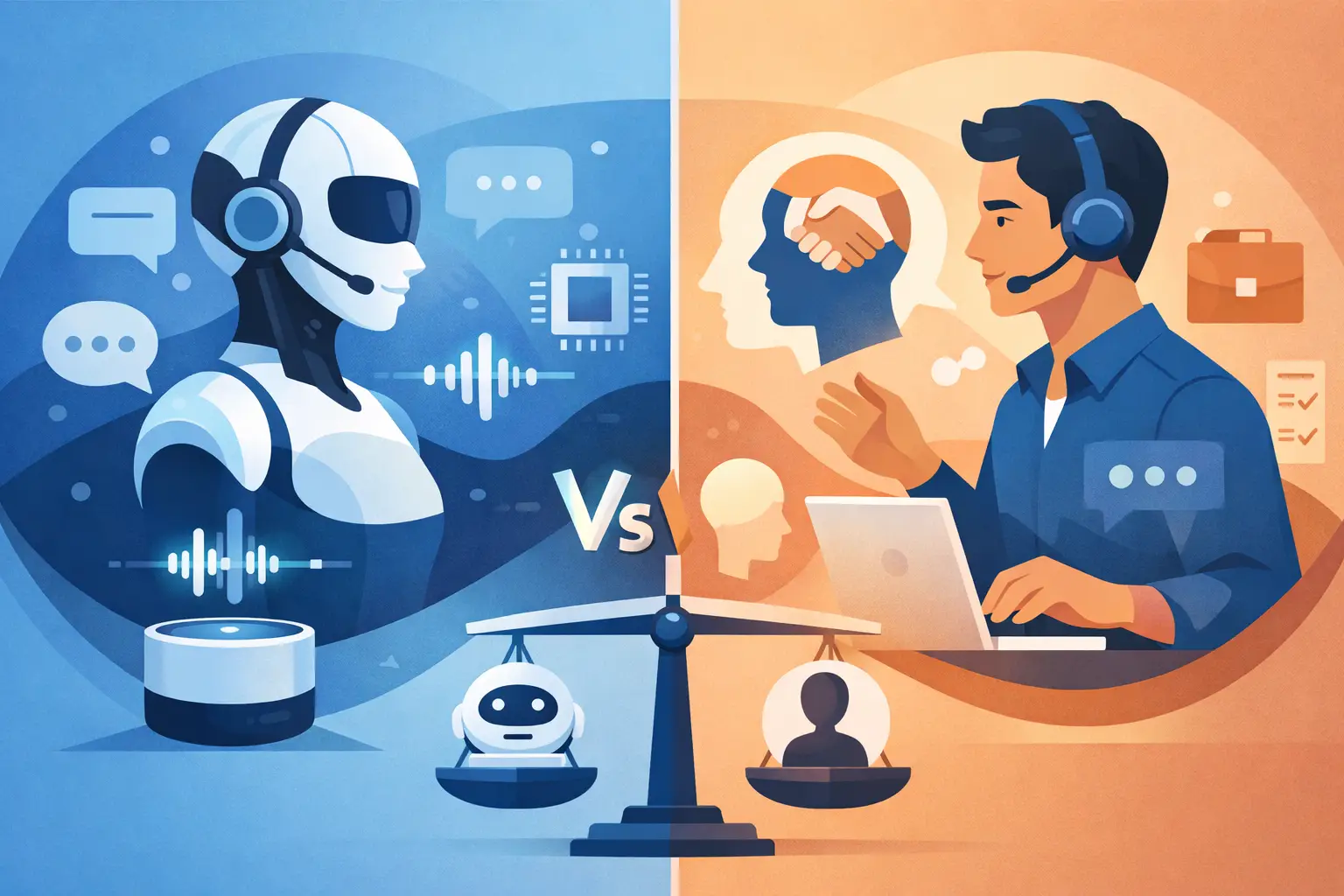
AI voice agents vs SDRs: the real difference
An AI voice agent is built for speed, volume, consistency, and immediate responsiveness. It can place calls at scale, follow a defined script, qualify simple criteria, route interested prospects, and log activity into connected systems without missing a step. It does not get tired, it does not need coaching between calls, and it can operate far beyond the throughput of an individual rep.
An SDR brings judgment, improvisation, and human credibility to the conversation. Strong SDRs can read tone, adapt to objections, navigate internal politics, and create momentum in situations where the buyer is skeptical, distracted, or only partially interested. They are not just making calls. They are managing conversations that often require timing, context, and business fluency.
That distinction is where most buying decisions get clearer. If your outbound motion depends on repetitive first-touch engagement and straightforward qualification, AI can carry a meaningful share of the load. If your market is complex, your deal size is high, or your buyers expect consultative interaction from the first call, human SDRs still matter.
Where AI voice agents outperform SDRs
The biggest advantage of AI voice agents is throughput. A human SDR has a hard ceiling. Even a disciplined rep can only make so many quality calls in a day, and performance tends to vary by experience, motivation, and management quality. AI voice agents do not have that problem. They can work larger lists faster, respond instantly, and maintain consistent messaging across every interaction.
That speed matters when you are working intent data, event-based triggers, inbound hand-raisers, or reactivation lists. The window for contact is short. If a prospect is researching a category, attending a webinar, or showing engagement signals, the first team to start a conversation often has the edge. AI voice agents are built for that kind of response time.
Cost structure is another major factor. Hiring, ramping, training, and retaining SDRs is expensive. Add management overhead, turnover, and uneven performance, and the true cost rises quickly. AI voice agents can lower the cost of top-of-funnel coverage, especially for companies that need more activity without building a larger outbound team.
They also improve process discipline. Every call can follow the same qualification logic, the same routing rules, and the same CRM logging standards. For revenue leaders who care about reporting accuracy and operational consistency, that is not a small benefit. Sloppy data creates bad decisions. Automated execution can reduce that problem.
Where SDRs still win
AI is efficient, but efficiency is not the same as persuasion. Human SDRs still outperform in conversations that require trust, nuance, and situational judgment. Buyers do not always answer direct questions with direct answers. Sometimes they test credibility. Sometimes they raise objections that have more to do with politics, timing, or internal alignment than product fit.
A good SDR can hear hesitation and change approach in real time. They can recognize when a prospect is interested but guarded. They can move off script without losing the thread. In enterprise sales, regulated industries, or founder-led outreach, that flexibility can make the difference between a dismissed call and a booked meeting.
There is also the issue of brand perception. Some audiences are comfortable engaging with AI in early outreach. Others are not. In markets where relationships and expertise carry more weight, a live SDR can create stronger first impressions. If your offer is high-ticket or your target accounts expect a polished, consultative introduction, human outreach often converts better.
SDRs are also better at surfacing insights that are hard to structure in advance. They can recognize competitor mentions, organizational changes, hidden pain points, and buying committee dynamics that might not fit neatly into a scripted qualification path. That information can materially improve downstream sales execution.
The trade-off is not human vs machine. It is task fit.
This is where many teams get the decision wrong. They compare AI voice agents and SDRs as if one should replace the other across the board. In practice, the better question is which parts of your outbound process need scale and which parts need human judgment.
AI voice agents are strong at immediate outreach, repetitive first touches, basic qualification, appointment scheduling, voicemail drops, call routing, lead reactivation, and after-hours coverage. SDRs are stronger when outreach requires account research, objection handling, strategic follow-up, and credibility with senior decision-makers.
If your current bottleneck is activity volume, speed to lead, or rep time wasted on low-value call tasks, AI can produce fast operational gains. If your bottleneck is meeting quality, conversion from conversation to opportunity, or penetration into complex accounts, adding more automation alone will not solve it.
AI voice agents vs SDRs by funnel stage
At the top of funnel, AI voice agents often have the edge. They can work large segments quickly, engage leads faster, and keep first response time low. For cold outreach at scale, especially where the initial goal is simple qualification or interest detection, that coverage is valuable.
In the middle of funnel, SDRs usually become more important. Once a prospect shows interest, the conversation often shifts from access to evaluation. Questions become more specific. Objections get sharper. Timing and fit matter more. That is where a skilled human can preserve momentum and improve show rates.
Closer to handoff, the best results often come from a combined model. AI handles the operational burden of outreach and scheduling. SDRs step in where context, persuasion, or account-specific thinking is needed. This creates a more efficient top-of-funnel engine without sacrificing meeting quality.
What sales leaders should evaluate before choosing
The right model depends on four things: deal complexity, audience expectations, outbound volume, and internal management capacity.
If you sell a lower-friction service into a broad B2B market and need more conversations quickly, AI voice agents can create meaningful leverage. If your buyers are technical, skeptical, heavily regulated, or part of long enterprise cycles, you will likely need human SDR involvement earlier in the process.
Volume also changes the math. If your team needs to touch thousands of records consistently, AI is hard to ignore. If your total addressable market is narrow and each account deserves careful treatment, a human-first approach may drive better returns.
Then there is management overhead. SDR teams require hiring, coaching, QA, scripting, motivation, and performance tracking. Many companies underestimate how much leadership attention that function consumes. AI reduces some of that burden, but only if the workflows, targeting, and escalation rules are set up correctly. Automation without strategy just creates faster waste.
The strongest outbound teams use both
For most growth-focused B2B companies, the best answer is not replacement. It is orchestration.
Use AI voice agents to handle speed, consistency, and repetitive call tasks. Use SDRs where conversation quality has the biggest impact on conversion. That structure gives you more coverage without forcing expensive human labor into every step of the process.
This is especially effective when paired with intent data, CRM integration, and multichannel sequencing. AI can prioritize and initiate. Humans can advance and qualify more deeply. The result is a cleaner pipeline model built around response time, better routing, and more efficient use of sales talent.
That is the practical advantage of a managed approach. Instead of debating tools in isolation, you build a system around outcomes: more qualified appointments, less rep drag, and clearer funnel economics. Appointment Gurus uses that blended model because sales leaders do not need more activity for its own sake. They need qualified conversations that convert.
The smartest move is to stop asking whether AI voice agents or SDRs are better in the abstract. Look at where your current process leaks time, misses speed-to-lead windows, or sends expensive human effort into low-yield tasks. That is usually where the answer shows up.